Grey bees
Grey BeesGrey bees are the bees Sergeyich comes to see as enlisted in war: in a nightmare, enormous bees dressed in military camouflage crawl from a hive toward his home, and he later recognizes that dream as a warning about the hive he destroys with a grenade. The image joins the practical vulnerability of a living colony to the beekeeper’s fear that war can recruit, redirect, and finally consume even the life he has spent years tending.
Appearance and First Meaning
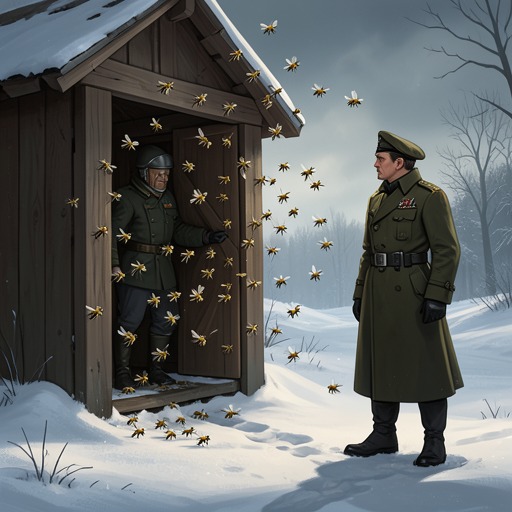
The bees acquire their military appearance in a dream. A hive stands apart in a field, and one enormous bee emerges, then sets off on two short legs toward the sunflowers. More follow, one after another, hunched over like scouts. Sergeyich first reads their grey color as camouflage clothing—perhaps overalls, perhaps raincoats, but unmistakably military in character. They leave in the same direction, toward his house in Little Starhorodivka, as though on a mission.
The dream makes an uncanny transformation out of the beekeeper’s familiar world. Bees that ordinarily fly, gather nectar and pollen, and live within the work of a hive instead crawl like soldiers, leaving their home in formation. The sunflowers remain a destination, but their meaning is divided: they are both the landscape of ordinary bee life and the setting for a military advance. The image does not make the insects actual combatants; it shows how Sergeyich’s experience of war shapes what he sees when he dreams about them.
The Beekeeper’s Work and the Threat of Recruitment
The contrast matters because Sergeyich’s relationship with his bees is intensely practical. He listens to the sound of their wings as evidence both that they are healthy and that he himself is present in the world. He understands their principal interest to be gathering nectar and pollen, and leaves the everyday relations among workers and drones to the bees. His responsibility is to protect their health: he drives away wasps, uncaps the honeycombs with a metal scraper, and gathers honey, wax, and pollen. The colonies’ queens reproduce, die, and are replaced within their hives without needing his advice or permission.
That ordinary order gives force to his alarm in the dream. He fears that the bees have been intimidated and recruited, and that they no longer belong to him or work for the purposes he understands. The imagined conversion is not simply a change in appearance: it replaces gathering pollen with a military mission and makes the hive’s inhabitants seem subject to an outside power. The fear speaks to a war in which people and places can be claimed by forces beyond their control, but the bees remain living creatures with their own needs, not merely symbols of human politics.
The Return of the Dream
Later, faced with the hive of bees that look grey to him, Sergeyich recalls the nightmare’s hunched, warrior-like figures crawling out as if from a tank turret or an underground tunnel. He also recalls another recent dream, in which strange figures loomed out of dark woods. He connects the visions and concludes that they are not accidental: dreams, he believes, are how God tells people what to do.
The recollection turns the dream into a guide for action. Sergeyich loosens the straps holding the officially inspected hive and its neighbor to the trailer, then pulls the grey-bee hive toward himself; it moves with surprising ease, as if his strength has returned. The supernatural certainty he draws from the dream sits beside a physical, deliberate act: he is separating a particular colony from the others before deciding what to do with it.
Destruction and Consequence
When Sergeyich finds a grenade in the hive, he considers whether to bury it, then imagines a tractor unearthing it and exploding. He also wonders whether the object might conceal equipment for spying on him and on the war. Leaving the hive uncovered, he backs toward the car, picks up the grenade, and weighs it in his palm. From about twenty metres away, he pulls the pin, throws it toward the grey bees, and throws himself to the ground. He does not see how close it explodes.
The blast presses his face into dry, black earth. A whistle and buzzing pass above him; something wet lands on the back of his head. He lies still, breathing through dirt until the thunder in his ears subsides into ringing silence. When he stands, the ground sways. The third hive is gone, replaced by a crater, scattered wood, and a fragment of honeycomb; one bee flies past. The dream’s military image culminates not in a battle but in the destruction of the hive, a real colony erased in an attempt to confront what Sergeyich understands as a threat.
Significance
Grey bees gather the book’s tension between human interpretations of war and the independent life of animals. Sergeyich’s apiary is not only an emblem: his work depends on particular colonies, queens, hives, weather, and the bees’ continuing labor. Earlier, when a swarm threatens to fly away, he mists it with water until its wings grow heavy and carefully gathers it into a trap, watching the last bees descend. This slow, attentive care stands against the grenade’s abrupt force and the crater left where a hive had stood.
The image also reverses the direction of the beekeeper’s usual authority. Sergeyich normally watches over the bees while leaving their internal order to them; in the nightmare, he fears they have been taken from him and turned toward a human destination. He interprets that fear through faith, then acts on it with an explosive weapon. The result is a painful gap between the colony’s actual life and the military meaning he has assigned to it: the bees’ buzzing persists in his imagination as the sound of war, while the surviving bee at the crater marks what remains after that interpretation has become irreversible.